Following cause and effect, this shot corresponds to the immediately previous one. It is normally used for dialogue between two characters and follows the so-called law of correspondence: an initial shot of character A, with a certain angle and value, corresponds to the symmetrical shot –or reaction shot- of character B, with an identical angle and value. This is always within the parameters of the 180 degree rule: for example, character A in the close-up looks to the right and in response character B, also in the foreground and with a symmetrical angle, looks left. Within the framework of cause and effect, the response to a look is also considered a reaction shot : the character looks and the reaction shot shows what they see (a landscape, an object or, without the need for symmetry, another character).
One of the main conventions of the audio-visual, present in all the genres, is that of the dialogue with the reverse angle shot
One of the main audio-visual conventions, present in all genres, is that of dialogue shown as a shot-reaction shot . This can be seen in silent and sound films throughout the history of the cinema, in films by all directors, from David W. Griffith to Jean-Luc Godard, from John Ford to Federico Fellini, Pedro Almodovar or David Fincher. In Persona (1966) by Ingmar Bergman, the complaint of the nurse Alma to the actress Elisabeth about her lack of affection toward her son is seen first through a four minute shot of the face of Elisabeth listening and straight afterwards the reaction shot of Alma talking, repeating the whole monologue.
Hana-bi. Fireworks
Hana-bi / Hana-bi feux d'artifice | Takeshi Kitano, 1997, Japan
Nishi (Takeshi Kitano) is a violent and unpredictable policeman who abandons his career as a law enforcement official after one of his colleagues, Horibe (Ren Osugi), is confined to a wheelchair after a difficult raid. Thereafter, Nishi devotes himself to taking care of his wife Miyuki (Kayoko Kishimoto) who is suffering from a terminal illness. Beset by debt as a result of paying for the treatment, Nishi is forced to borrow from the yakuza organised crime syndicate and then has difficulty repaying the money. While Nishi and Miyuki undertake what will be their last trip as a couple, Horibe discovers painting as an escape from his hopelessness, resulting in surrealistic artworks of great beauty that will make him forget his suicidal tendencies.
When I write a script, I have the entire film in my head, so when we start shooting, I just do it. I’m more interested in the editing process, so I tend to shoot in a hurry. Maybe you don't always have enough footage, but how you play around with it, is what is interesting
Takeshi Kitano
(1947)
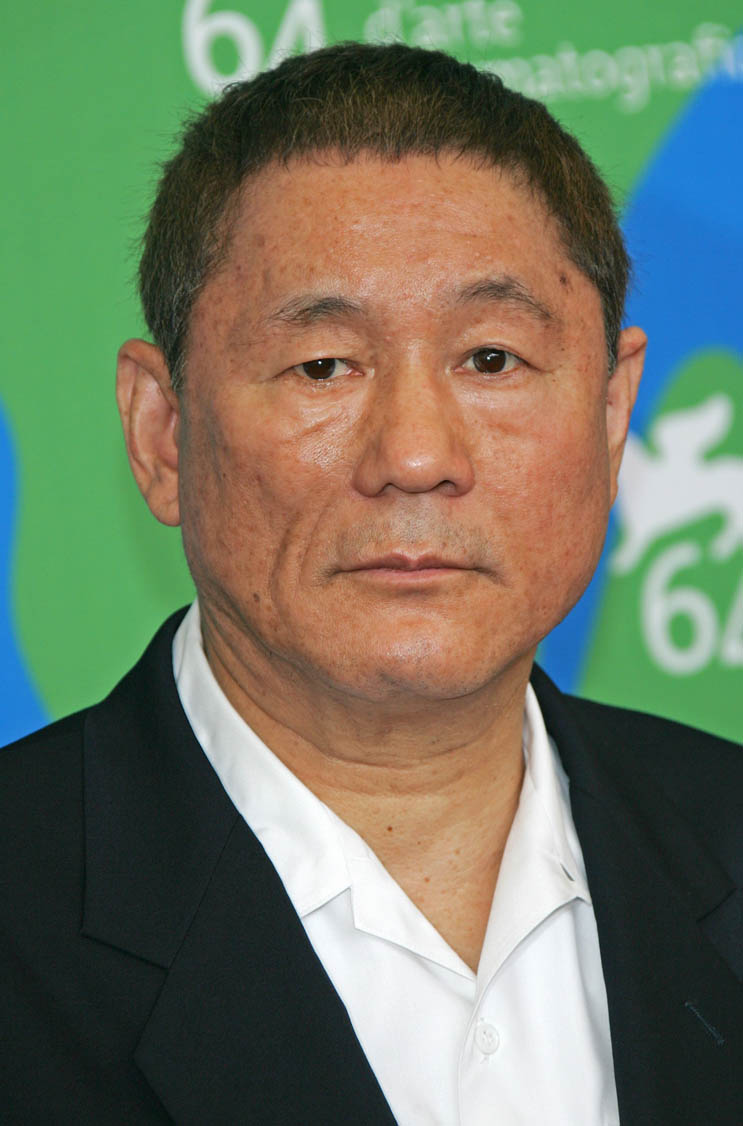
Until his final consecration as one of the most important Japanese filmmakers of recent decades, the actor, director, comedian, writer, poet, painter and video game designer Takeshi Kitano was known in his country primarily as a television personality and member of the comedy duo Two Beat. However, it is his filmmaking that has made him famous in the rest of the world, where he has received unanimous critical acclaim. Born on 18 January 1947 in the Adachi district of Tokyo, after completing his secondary education Kitano attended Meiji University to study engineering, a course which he never finished. His first steps in the world of show business were as a comedian in a nightclub where he originally worked as an elevator operator. Kitano achieved success in his country in the 1970s as a comic when he was part of a comedy duo with Kiyoshi Kaneko. In this period he adopted the stage name Beat Takeshi and became a TV celebrity thanks to his huge satirical skill and his politically incorrect humour, creating among other programmes the famous Takeshi's Castle. In the 1980s, Kitano had his debut as an actor on the big screen, one of his most important films from that period being Merry Christmas Mr. Lawrence (Senjō no Merī Kurisumasu, by Nagisha Oshima, 1983), starring David Bowie. Six years later, Kitano threw himself into the world of directing, replacing a sick Kinji Fukasaku at the head of a modest yakuza film Violent Cop (Sono otoko, kyōbō ni tsuki, 1989) in which he also played the lead role. After that accidental debut came the increasingly personal, disconcerting, melancholy and fascinating Boiling Point (San tai Yon ekkusu Jugatsu, 1990), A Scene At The Sea (Ano natsu, ichiban shizukana umi, 1991), Sonatine (Sonachine, 1993), Getting Any? (Minnā yatteru ka!?, 1994) and Kids Return (1996). In 1997 he wrote, directed and starred in the first of his masterpieces, FIREWORKS (HANA-BI), a criminal drama for which he won the Golden Lion at the Venice Film Festival. Now one of the most respected contemporary directors of his generation, and without ever neglecting his parallel career as an actor inside and outside his country, Kitano has continued winning awards and prestige with titles such as Kikujiro (Kikujiro no Natsu, 1999), Brother (2000), Dolls (2002) and Zatoichi (2003), a classic samurai story with which he won a Silver Lion in Venice. Increasingly Fellinian and self-referential, his very individual filmography has been completed with, among others, such atypical, experimental and whimsical works as Takeshis (2005), Glory to the Filmmaker (Kantoku · Banzai!, 2007) and Achilles and the Tortoise (Akiresu to Kame, 2008). After more than 30 years of his prolific career, Kitano today continues to be one of the most outstanding and emblematic Japanese personalities. He continues taking part in television programmes and specials, painting, giving one-off classes in the university and publishing novels, collections of stories, essays and poetry.