This is action that takes place beyond the limits of the framing and that can only be perceived by the viewer through sound or imagined from the narrative.
The suggestion effects of outside the field normally provide poetic sense including in the most violent sequences
The suggestive power of off camera is often used in the horror genre. For example, in The Blair Witch Project (1999), with the screenplay, direction and editing by Daniel Myrick and Eduardo Sánchez, we never see any of the threatening phenomena that fill the soundtrack. The suggestive effects of off camera often give a poetic feel to even the most violent sequences: in Ulysses' Gaze (To Vlemma Tou Odissea, 1995) by Theo Angelopoulos, the gunning down of various characters occurs off camera because of the fog that only allows the main character to be seen. In the final shot of The Ghost Writer (2010) by Roman Polanski, we are aware of the murder of the protagonist once he has left the shot through an crash on the soundtrack that suggests a car accident and from the flying around of the papers he was carrying under his arm, which gradually come back into camera at the end of the shot.
Code Unknown
Code Unknown / Code inconnu: Récit incomplet de divers voyages | Michael Haneke, 2000, France/Germany/Romania
An unfortunate gesture by a teenager triggers a series of events that link the lives of several characters from different social classes and geographical locations. It is set in multicultural Paris the end of the 1990s. The background is the Europe of one thousand and one speeds. In the foreground, a schizophrenic and fragmented society, a place where luxury and misery live side-by-side, along with the boredom of the middle classes and the desperation of the deprived. Haneke shows snapshots of several characters who intersect, collide and are ignored in a European metropolis. Characters who do not know how to react when violence explodes before their eyes, who complicate the lives of others when they try to help them, who are scared of a loneliness that they themselves have been constructing: like Anne (Juliette Binoche), an actress haunted by her own ghosts on and off the screen; or Georges, a war photographer unable to reintegrate into civilised Europe; or Amadou, a young Senegalese teacher working with deaf children but who knows he is hostage to his own anger; or Mary, a Romanian immigrant who is forced to beg to support the family.
It’s not that I hate mainstream cinema. It’s perfectly fine. There are a lot of people who need to escape because they are in very difficult situations so they have the right to escape from the world. But this has nothing to do with an art form. An art form must confront you with reality
Michael Haneke
(1942)
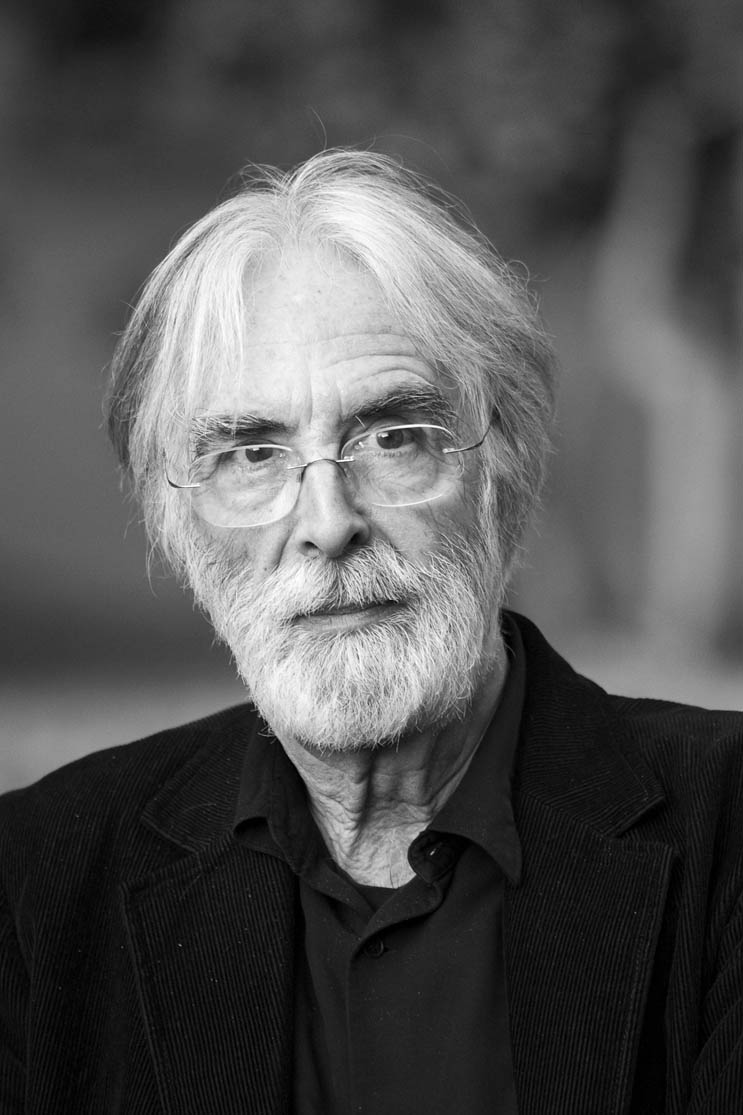
Austrian by adoption, the German director and screenwriter Michael Haneke was awarded the Prince of Asturias Award for the Arts in 2013, an award that confirmed the enormous depth of his unforgiving filmography, without doubt one of the most polemic, controversial, radical and lucid seen in recent decades. Considered one of the most prestigious active avant-garde film-makers, his films are, in his own words, "slaps in the face". Son of the director and actor Fritz Haneke and the actress Beatrix von Degenschild, after the divorce of his parents Haneke spent his childhood in the countryside with his mother's family, close to Wiener Neustadt, Austria. Obsessed with film from a very early age, and after failing to gain entry to the Max Reinhardt School, Michael decided to study Philosophy, Psychology and Drama at the University of Vienna, shortly afterwards starting work as a film critic. From 1967 he worked as editor and dramaturg in a television network in southern Germany, where he also began working intensely as a theatre director. His film début came through The Seventh Continent (Der siebente Kontinent, 1989), a bleak family drama based on real events and the first film from his chilling trilogy about "emotional glaciation", a trilogy that he completed with the no less shocking Benny's Video (1992) and 71 fragments of a chronology of chance (71 Fragmente einer Chronologie des Zufalls, 1994). He received international recognition in 1997 with Funny Games, a metalinguistic cult film from which he himself shot his mimetic American remake in 2007. With The Piano Teacher (Die Klavierspielerin, 2001), a very hard adaptation of the novel by the Austrian writer Elfriede Jelinek, he won the Grand Jury Prize at the Cannes Film Festival. After the somewhat of a failure Time of the Wolf (2003), Haneke triumphed again in the same event taking the Best Director Award with Caché (2005) and the Palme d'Or twice, first with his double Oscar nominee The White Ribbon (Das weiße Band, Eine deutsche Kindergeschichte, (2009), and more recently with the sad Love (Liebe, 2012). Since 2002 he has been teaching film direction at the Film Academy Vienna (Filmakademie Wien) where he tries to pass on his film knowledge to his students, with a special emphasis on the direction of actors.