This is a type of transition consisting in the progressive disappearance of one image while another is generated to replace it. Unlike the cut transition, which is usually intended to go unnoticed, the intention of the dissolve is to be obvious to the audience so that it can generate a meaning, such as a return to the past, an ellipsis or an identification or contrast of forms. It can also mean nothing concrete beyond the creation of beauty. If the movement from one shot to another contains an error, the dissolve is also a plausible solution to diminish the bad effect.
The history of the dissolve - also called "crossfade" and "fade" - began before cinema itself, with magic lantern shows, such as the phantasmagorias or horror shows of the late eighteenth and early nineteenth centuries, where the image from a first lantern projector would fade while a new image emerged from a second. The dissolve entered the world of cinema with the early films of pioneering film-makers such as Georges Méliès, especially in various special effects. Gradually, the dissolve has taken on more meanings, as a sign of a movement in time, into the future or back to the past, or the transition to a dream or reality, as in Dream and Reality (Reve et realité, 1901) by Ferdinand Zecca, in which a man kisses a beautiful woman who, after a dissolve, appears to be very unpleasant.
The intention of fading is to be shown to the spectator in order to generate a meaning, which may be a return to the past, an ellipsis or an identification or contrast of forms
In the opening sequence of the death of Charles Foster Kane in Citizen Kane (1942), directed by Orson Welles, the approach to the castle of Xanadú is produced using several dissolves that all keep the light from the window of the building in the same place in the frame. The short film The Jetty (La Jetée, 1962) by Chris Marker, made using voiceover, music and images lacking movement, uses dissolve as the main form of transition. Martin Scorsese also uses it in his own way by dissolving characters who walk from the background to the foreground, thus shortening the journey time, as can be seen in Taxi driver (1976) and After hours (1985).
Apocalypse now
Apocalypse Now / Apocalypse Now | Francis Ford Coppola, 1979, U.S.
Loosely based on Heart of Darkness by Joseph Conrad, the film tells how in Saigon, during the Vietnam War, and presumably around 1969, the troubled US army captain Benjamin L. Willard (Martin Sheen) receives a direct order from his superiors that will radically change his life: the top secret mission is to find and kill Colonel Kurtz (Marlon Brando), a serviceman with an impeccable track record who seems to have lost his mind and is taking refuge in the heart of Cambodia with a Montagnard native tribe who worship him as a primitive deity. To achieve this, Willard must go up the Nung River in a navy patrol boat accompanied only by a handful of soldiers.
If we cannot experiment as cinema pioneers, how are we going to get cinema to evolve, what are the films of our grandchildren going to be like
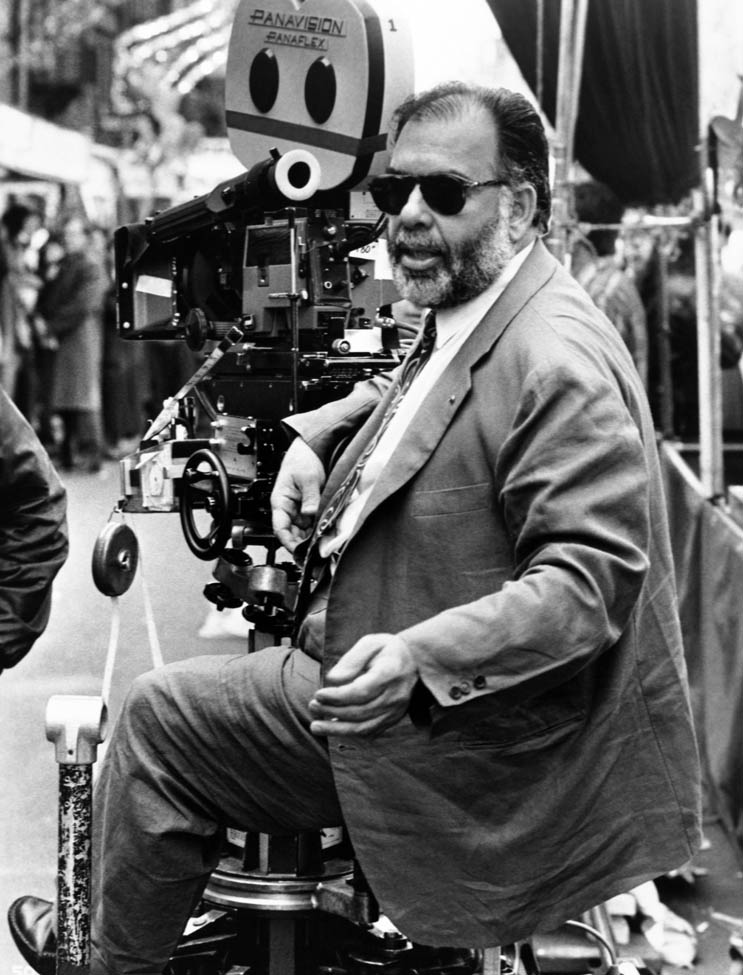
Francis Ford Coppola
(1939)
Considered one of the most important and influential directors of all time, the legendary Francis Ford Coppola, one of the leading founding figures of the so-called New Hollywood, was born in Detroit on 7 April 1939 in the heart of a family of Neapolitan immigrants. Son of the composer Carmine Coppola and the actress Italia Pennino Coppola, aged nine he contracted polio which forced him to stay in bed for a long time and depend on the care of his elders in his early adolescence. After graduating from the film school at the University of Los Angeles, he worked with Roger Corman on several horror films, a task that he combined with his early projects as a director, which received a lukewarm response from audiences and critics alike. In 1970 he received the first of his six Oscars for his work as a screenwriter on Patton (Franklin J. Chaffner). This prompted Paramount to hire him as the screenwriter and director of The Godfather (1972). Winning three more Academy awards, the film was a box office hit and even today is a true symbol of the best of 1970s cinema. Made by Coppola when he was only 33, his Shakespearean adaptation of the novel by Mario Puzo demonstrated his great creative maturity as a film-maker. Thanks to this film, Francis Ford Coppola acquired the financial means and prestige necessary to develop and produce his own films as part of the American company Zoetrope, a company that he himself founded in 1971 and which employed directors such as Martin Scorsese and George Lucas. Before literally embarking on what is undoubtedly his masterpiece, the monumental Apocalypse Now (1979), Coppola would repeat his success with The Godfather II (1974), a return to the Puzo saga that he finally finished off in 1990 with The Godfather III. The shooting of Apocalypse Now in the Philippines, which took more than two years, was beset by all sorts of problems, including a typhoon that destroyed many of the sets. The film was a gruelling experience for the whole team: Coppola had to mortgage his own house to secure the funding he needed to finish the shooting, and Martin Sheen was close to death after having a heart attack. The limited commercial success of this undisputed masterpiece (which the director recut and launched on the market in 2001 under the title Apocalypse Now Redux), coupled with the resounding failure of his visionary One From The Heart (1982), marked the end of the American company Zoetrope, forcing Coppola to shoot lower-budget but equally memorable films during the 1980s, such as The Outsiders (1983), Rumble Fish (1983) and Cotton Club (1984). The resounding success in 1990 of The Godfather III allowed him to again embark on larger projects of a more operatic scale, such as the equally successful Bram Stoker's Dracula (1992). After that came rather more conventional "feeder" titles, such as Jack (1996) and The Rainmaker (1997), and at the start of the new millennium he dedicated himself almost exclusively to the production of foreign films (such as those of his own daughter, the extremely talented Sofia Coppola), the one-off shooting of his own very low budget projects (like Tetro, 2009, and Twixt, 2011), and to his work as an entrepreneur in areas as far away from the world of cinema as the wine and hospitality industries. In 2015 he was awarded the Princess of Asturias Award for the Arts.