This involves a variable focal length lens that allows us to zoom in or zoom out on the image at will without altering the position of the camera. The term "zoom" comes from the model created by the German Frank G. Back in 1959 for 35 mm cameras. It was popularised from the sixties but there are many historical precedents for this type of lens, one of these being that of the film maker from Granada, José Valdelomar (1904-1982), who in 1928 patented a variable focal lens with the same characteristics as the "zoom" to, in his own words, "penetrate the soul of the human being."
The term zoom comes from the model created by the German Frank G. Back in 1959 for 35 millimetre cameras which was popularised from the seventies
At the start of Death in Venice (Der Tod in Venedig, 1971), by Luchino Visconti, the film zooms in on the image of Gustav Aschenbach, the protagonist, sitting on the Vaporetto, moving from long shot to medium shot. The combination of travelling and zoom, track-zoom or dolly-zoom (travelling forward and zooming back or vice versa), provides the sense of approaching something or someone that stays still while the background moves away from us, or the other way round. It is a device that reflects altered visions of reality and was used for the first time in Vertigo (1958) by Alfred Hitchcock, and later on many occasions such as in Michael Jackson’s video Thriller (1983), directed by John Landis. The so-called crash zoom, typically the product of a special effect, allows for very quick zooming in and out. One example is the movement from the overhead shot of the city of Berlin to a red telephone at the start of Run Lola Run (Lola rennt, 1998) by Tom Tykwer.
The Kubrick zoom
It includes fragments of A clockwork orange (1971), Barry Lyndon (1975), The Shining (1980) and Full Metal Jackett (1987).
If it can be written, or thought, it can be filmed
Stanley Kubrick
(1928-1999)
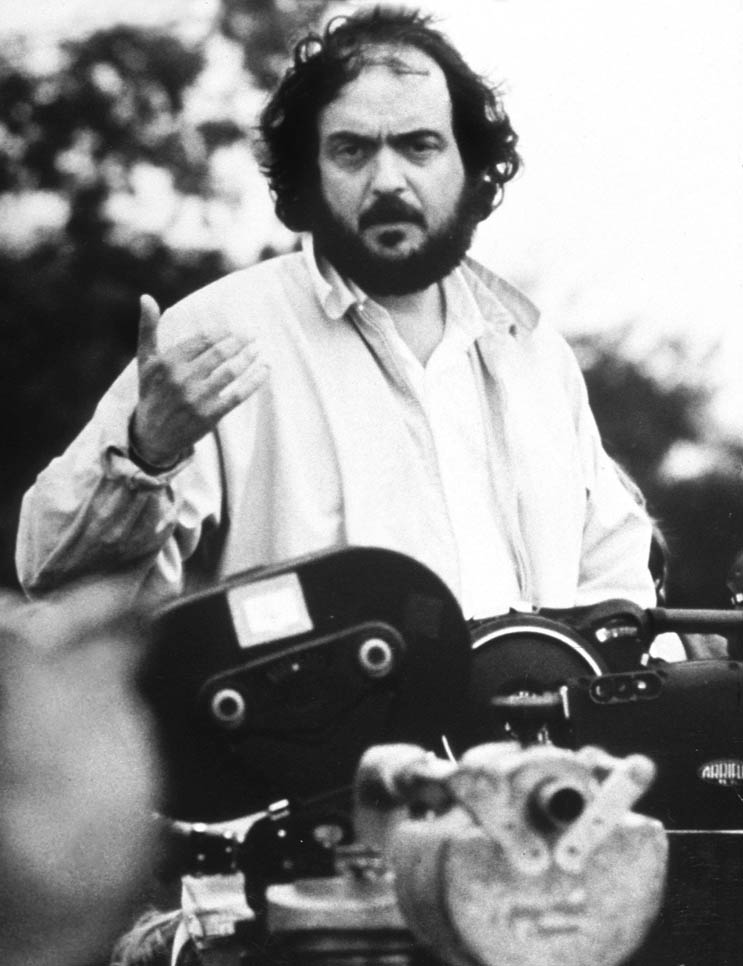
Considered by many as one of the most influential film-makers of the twentieth century, Kubrick stood out both for his almost obsessive technical precision and for the great styling and marked symbolism of his films. Director, screenwriter and producer, Stanley Kubrick was born in New York on 26 July 1928. A bad pupil when he was young, his parents tried to motivate him by sending him to California to live in Pasadena with his maternal uncle, Martin Perverler, who was an important figure in his later film career as he helped him finance his first film projects. Stanley's main interests were cinema, reading, chess and photography, a hobby that helped him earn his first professional contract to work for Look magazine. He made his début as a film director with a series of documentaries filmed in the early 1950s. His first work of fiction was Fear And Desire (1953), a low-budget war drama which he followed up with the also low-budget The Killer’s Kiss (1955), a noir story clearly inspired by pulp noir. His first major film was The Killing (1956), an independent production clearly influenced by the films of Fritz Lang, John Huston, Samuel Fuller and Akira Kurosawa. From that moment, all his films would be considered true works of art in each of the many genres he worked in: war films with Paths of Glory (1957), peplum with Spartacus (1960), literary adaptation with Lolita (1962), political satire with Dr. Strangelove or: How I Learned to Stop Worrying and Love the Bomb? (1964), science fiction with 2001: A Space Odyssey (1968), period drama with Barry Lyndon (1975) and terror with The Shining (1980). The enormous influence of his legacy can still be seen today, formally, technically and even conceptually, in the work of such important film-makers as Steven Spielberg, Quentin Tarantino, Christopher Nolan, Wes Anderson, Darren Aronofsky, Gaspar Noé, the Coen brothers, Paul Thomas Anderson and Jonathan Glazer.